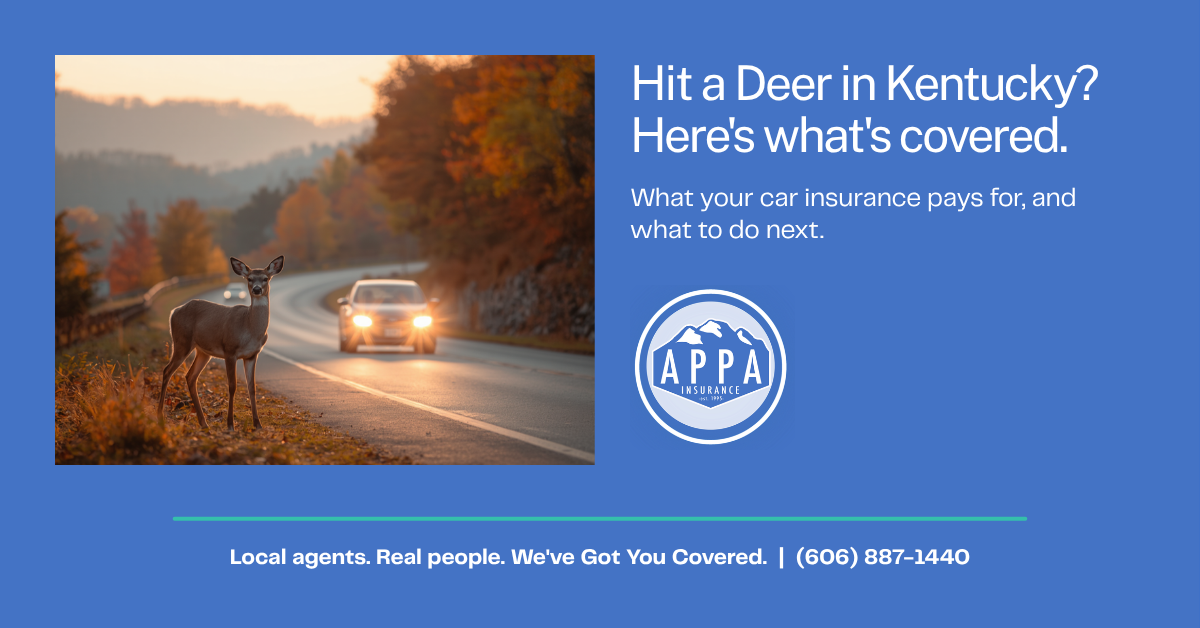
Yes, car insurance usually covers hitting a deer in Kentucky, but only if you carry comprehensive coverage. Hitting an animal is typically paid under comprehensive (sometimes called “other than collision”), not collision, and not liability. If your policy is liability-only, the damage to your own car comes out of your pocket. And here’s the twist most people miss: if you swerve to miss the deer and hit a tree or guardrail instead, that’s usually a collision claim, with a different deductible.
With deer season and the fall rut in full swing across Eastern Kentucky, here’s what you need to know before you’re the one pulled over on KY-80 at dusk.
Why is a deer collision a comprehensive claim and not collision?
It sounds backwards. You collided with something, right? But in a standard personal auto policy, the two physical-damage coverages are split like this:
- Collision pays when your car hits another object (another car, a tree, a guardrail, a ditch) or rolls over.
- Comprehensive pays for most other physical damage: theft, fire, hail, falling objects, vandalism, flood, glass breakage, and contact with a bird or animal.
So a deer that runs into your grille or hood falls under comprehensive. Both coverages are optional unless you have a car loan or lease, in which case the lender almost always requires them.
What if I swerve to miss the deer and hit something else?
This is where people get surprised. If you jerk the wheel, miss the deer, and slide into a tree, a rock face, or a ditch, you didn’t hit an animal. You hit an object. That’s a collision claim.
Why it matters:
- Your collision deductible may be higher than your comprehensive deductible.
- A single-car collision may be treated differently by your insurance company than an animal strike.
- If you only carry comprehensive and not collision, the swerve could leave you with no coverage for your own car.
Safety experts generally advise drivers to brake firmly and stay in their lane rather than swerve, because leaving the road or crossing the center line can cause a far worse crash. On our twisty two-lane roads, that advice counts double.
How much will my insurance pay for deer damage?
Your insurer pays the cost to repair the damage, up to the car’s actual cash value (ACV, meaning what the car was worth right before the accident, factoring in age and wear), minus your deductible. If repairs cost more than the car is worth, it’s usually declared a total loss and you’re paid the ACV, minus the deductible.
A real-numbers example from Floyd County
Say you’re driving your pickup home to Prestonsburg just after sunset in early November. A doe jumps out, and you hit her square. The body shop estimate comes back at $4,800 for a bumper, grille, headlight, hood, and radiator.
| Scenario | Coverage that applies | Deductible | Insurance pays | You pay |
|---|---|---|---|---|
| You hit the deer | Comprehensive | $500 | $4,300 | $500 |
| You swerve and hit a guardrail instead | Collision | $1,000 | $3,800 | $1,000 |
| You carry liability-only | None for your truck | — | $0 | $4,800 |
Same deer, same road, three very different outcomes. (These are illustration numbers; your deductibles and repair costs will vary.)
Will a deer claim raise my insurance rates?
It depends on your insurance company. Many carriers don’t treat a comprehensive claim like an at-fault accident, because you didn’t cause the deer to jump out. But each company sets its own rules, and multiple claims in a short window can affect your renewal. If you’re unsure, call us before you file. We can walk through how your carrier typically handles it.
What about injuries and a rental car?
Comprehensive only pays for damage to your car. Other parts of your policy may step in:
- Injuries: Kentucky is a “choice no-fault” state, so most policies include Personal Injury Protection (PIP), which can help pay medical bills and lost wages for you and your passengers no matter who was at fault. Medical payments coverage, if you carry it, can help too.
- Rental car: Many policies include limited transportation expense, or you can add rental reimbursement coverage. Without it, getting to work in Pikeville while your truck sits in the shop for two weeks is on you.
- Towing: Roadside assistance or towing and labor coverage is a cheap add-on that’s worth having on rural roads.
“I have full coverage, so I’m fine, right?”
Here’s what most people get wrong: there’s no such thing as “full coverage.” It’s a nickname, not a policy. Usually people mean liability plus comprehensive plus collision. But plenty of drivers who say “full coverage” actually dropped comprehensive on an older car to save money, or carry a $2,500 deductible they forgot about. The only way to know is to look at your declarations page, the summary page at the front of your policy.
What should I do right after hitting a deer in Kentucky?
- Pull over safely and turn on your hazard lights. Stay off the road if it’s dark.
- Don’t approach the deer. An injured deer can kick hard and hurt you badly.
- Call 911 if anyone is hurt, the car can’t be driven, or the deer or debris is blocking the road. A police report can help with your claim.
- Take photos of your car, the scene, and any hair or blood on the vehicle. That evidence helps show it was an animal strike, not a collision.
- Check before driving. Look for leaking fluids, broken lights, or a hood that won’t latch.
- Call your agent to start the claim and ask about towing and rental options.
How do I lower my odds of hitting a deer?
- Slow down and stay alert at dawn and dusk, when deer move most.
- Where you see one deer, expect more. They travel in groups.
- Use high beams on empty back roads, and watch for eye shine along the shoulders.
- Take deer-crossing signs seriously. They’re posted where crashes keep happening.
- Remember that October through December is peak season, with the rut and hunting season keeping deer on the move.
Frequently asked questions
Does liability insurance cover hitting a deer?
No. Liability pays for damage and injuries you cause to other people. It doesn’t pay to fix your own car after a deer strike. You need comprehensive for that.
Is hitting a deer considered an at-fault accident in Kentucky?
Usually it isn’t treated as at-fault, because it’s typically a comprehensive claim. But how a deer claim affects your rates is set by each insurance company, so ask your agent.
Do I have to pay a deductible if I hit a deer?
Yes. Your comprehensive deductible applies. Some drivers choose a lower comprehensive deductible than their collision deductible for exactly this reason.
Does insurance cover a deer hitting my parked car?
Generally yes, if you carry comprehensive. Contact with an animal is covered under comprehensive whether the car is moving or parked.
Should I keep comprehensive on an older car?
It depends on what the car is worth and what you could afford to replace. In deer country, comprehensive is often inexpensive compared with a $3,000 to $5,000 repair bill. We can run the numbers with you.
Not sure if you’re covered for deer season? Let’s check.
At APPAinsurance, we help drivers across Kentucky, Tennessee, and West Virginia make sure their auto policy actually fits the roads they drive. We’ll look at your comprehensive and collision deductibles, rental coverage, and anything you might be missing, in plain English.
Call us at (606) 887-1440 or get a free quote online.
Local agents. Real people. We’ve Got You Covered.
Coverage depends on your specific policy, insurance company, and state. This article is general information, not a coverage determination. Read your policy or talk with a licensed agent for details on your situation.